




Local Delivery Options Available

Quick Turnaround

Quality Bespoke Glass Products
How do one-way mirrors work?


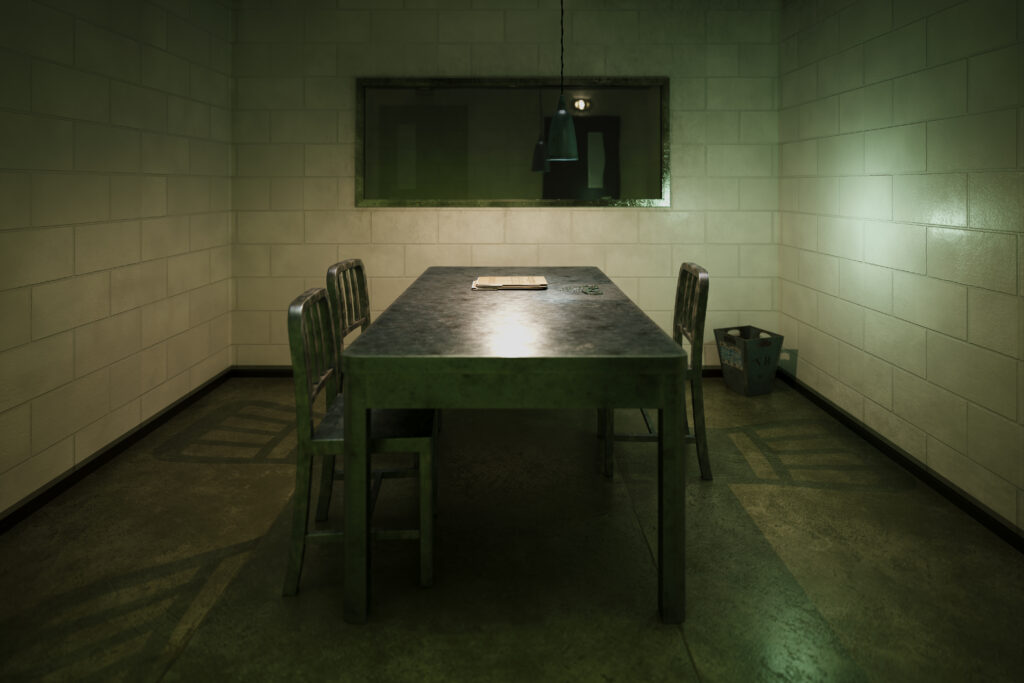
No crime drama would be complete without a one-way mirror being used in a tense interrogation scene.
Not only is it a staple of our favourite thriller scenes, but the one-way mirror is also an essential part of real police procedures.
They allow detectives to watch into an interrogation room from behind a pane of dark glass. This means they can see into the room, while being invisible to the suspect (who only sees a mirror).
But how do they work? In this article, we outline how one-way mirrors differ from conventional mirrors, and how they achieve this key optical effect.
What is a One-Way Mirror?
A one-way mirror is a piece of glass, which is designed to appear reflective on one side and then transparent on the other.
This means that on one side, the viewer will see a mirror, and on the other, the viewer will be able to see through to the other side, as if they were looking through a window. This is known as a ‘unidirectional’ viewing effect.
One-way mirrors are most commonly used in settings where covert observation is required. Or, they can be used in locations where people want to increase their privacy, but still want to be able to keep their original view.
As a result, one-way mirrors are widely used in:
- Interrogation rooms
- Market research and focus groups (allowing the researchers to observe focus groups, without influencing their responses)
- Monitoring security (e.g. in banks)
- Residential / office building exteriors
- Smart mirrors (e.g. mirror glass displaying the time or other digital updates)
How Do One-Way Mirrors Work?
A typical household mirror is created by applying a thick, opaque layer of reflective metal (such as aluminum) to the back of a sheet of glass. The thickness of the layer ensures that 100% of the light that hits it is successfully reflected.
One-way mirrors differ, in that they use a half-silvered surface. This means that they are manufactured by applying an extremely thin layer of reflective metal to the glass. This layer is so thin that the glass is not fully opaque. Rather than the 100% reflection of standard mirrors, these mirrors become ‘partial mirrors’, meaning they only reflect around half the light that hits them. They allow the other half of the light to pass through the mirror.
But, how does this mean that only one side is transparent?
Well, the role of lighting is critical here.
In reality, a one-way mirror is not designed to allow light through on one specific side. If the one-way mirror was set in a room that had equal lighting on either side of the mirror, then it would just appear as a tinted window.
The one-way effect is only achieved if there is a contrast in lighting between the two settings. So, in order for a one-way mirror to work as intended, the ‘subject side’ (the side that views the one-way mirror as a mirror) must be much brighter than the ‘observation side’ (the side that views the one-way mirror as a transparent pane).
How to Maximise this Effect
This effect is achieved by setting the correct contrast between the two directions:
- On the bright side: As there is so much more light hitting the glass, the 50% of light that the mirror reflects back overwhelms the small amount of light that is coming through from the dark room on the other side. As a result, for the person in the bright room, the glass appears as a mirror.
- On the dark side: As there is so little light reflecting back at the viewer within their own room, they predominantly see the light that’s passing through to them from the bright room. So, they see the glass appearing as a tinted window.
To maximise this effect to the fullest advantage, the ideal light ratio should be achieved between the two rooms. This is usually 10:1.
Sometimes, one-way mirrors are manufactured to feature a grey or bronze tint. This is designed to absorb light as it passes through the glass, thereby making the reflective side of the mirror look even more like a standard mirror.
How are One-Way Mirrors Made?
One-way mirrors are made following a process called vacuum sputtering.
This involves placing the glass in a vacuum chamber containing a metal electrode. Then, ions knock metal atoms off the electrode.
These atoms settle onto the surface of the glass, resulting in an even and extremely thin layer of metal.
At Stevenage Glass, we are one of the UK’s leading glaziers, serving the trade and public since 1966. To find out more about one-way mirrors, or to place an order with our trusted team, don’t hesitate to get in touch.